
Email Marketing for Self-published Authors: How to Build an Audience You Actually Own
One of the hardest things for self-publishing authors is marketing, without a doubt.
If you’re an author, you’ve probably been trying to build a social media following.
Post consistently. Grow your Instagram. Get on TikTok. Build your platform.
All useful advice, sure!
But there’s one thing I’d put above all of it: build an email list.
Because your social media followers aren’t really yours.
You’re building that audience on someone else’s platform. You don’t control the algorithm, your reach, or what happens to your account tomorrow.
An email list works differently. When a reader gives you their email address, you have a direct way to communicate with them.
All you need to do is send them an email. That’s the real value of email marketing for authors.
Social media gets you discovered. Email keeps you connected.
Social media is great for discovery.
Your readers see your post. They like your writing. They follow you. Maybe they check out your books too.
But what happens after that?
Most of us follow hundreds of accounts, and your audience isn’t any different. The algorithm decides what they see. You might have 10,000 followers and still reach only a fraction of them.
But if someone has willingly joined your email list, you can show up in their inbox.
You can tell them about your new book, share a cover reveal, send a deleted scene or bonus chapter, tell them what you’re currently writing, or invite them to join your ARC team.
This gives you a way to build an ongoing relationship with your readers.
You can always start small
This is where I think authors sometimes overcomplicate email marketing.
You don’t need a huge list before you start.
A list of 100 genuinely interested readers is more useful than a list of thousands of people who signed up randomly and never open your emails.
Inbox providers are paying increasingly close attention to engagement. Opens, clicks, replies, and whether people actually want your emails matter.
So it’s okay to start with a small subscriber count. The important part is that you have readers who are engaged with you.
That brings us to the next point.
Start with a reader magnet
One of the easiest ways to get readers onto your list is to give them something in return.
This is usually called a reader magnet.
For fiction authors, it doesn’t have to be complicated.
Depending on your genre, it could be:
- A bonus scene
- A prequel novella
- A short story
- An alternate POV chapter
- A character interview
- A deleted scene
- A map or world-building guide
- A collection of bonus content
The important part is that it should appeal to someone who is actually interested in your type of books.
If you write fantasy, give fantasy readers something they want from your book world.
If you write romance, give romance readers something that makes them want more of your world or characters.
The goal is to attract potential readers, not just collect email addresses.
Put your signup where your readers already are
Give readers multiple opportunities to sign up.
Your social media bio is an obvious one. Your website is another.
Here’s an example:
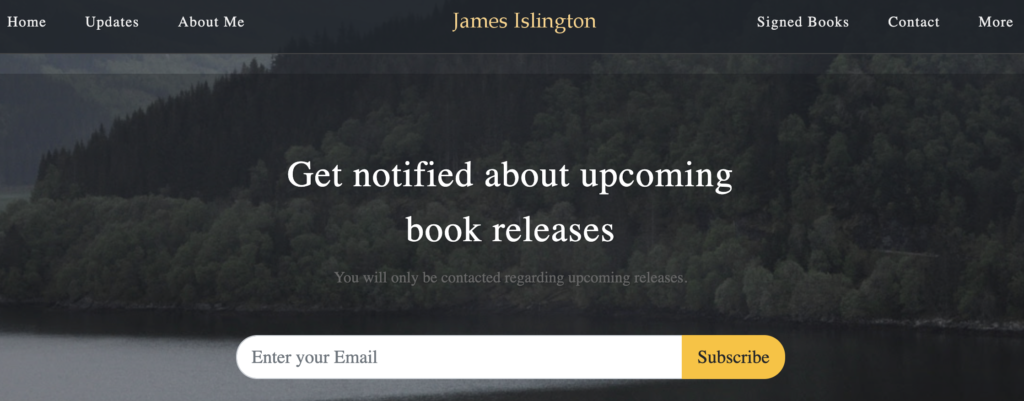
Source: James Islington
But one of the most valuable places is actually inside your book.
Put a call to action in your back matter
Think about the moment immediately after a reader finishes your book.
They’ve just spent hours with your characters. They’re emotionally invested.
They’ve reached The End.
That’s a pretty good moment to say:
Want more? Join my reader list for [your bonus].
You can also say something like:
Get updates on Book 2 by joining my email list.
Put the signup CTA in your back matter, before the acknowledgments if it makes sense for your book.
You can also include a QR code in your paperback that takes readers directly to your signup page.
Make it easy for readers to join your list.
Pick an email platform
You’ll need an email marketing platform to collect subscribers, send newsletters, and automate things like welcome emails.
There are plenty of options, but you don’t need anything overly complicated when you’re starting out. MailerLite, Kit, and Mailchimp are some of the better-known options for authors.
Look at the pricing, subscriber limits, automation features, and how easy each one feels to use. Then pick the one you’re actually comfortable sticking with.
The best platform is the one you’ll use consistently.
Then build a simple welcome sequence
Someone signs up.
Now what?
Don’t send them one automated email with a download link and disappear for six months.
This is where a simple welcome sequence helps.
You could start with 2–3 emails.
A few ideas:
Email 1: Deliver the reader magnet and welcome them.
Email 2: Tell them a little about you and your books.
Email 3: Give them something useful or entertaining related to your story or genre.
You can add more emails later if you need them. It doesn’t need to be a complicated funnel.
The reader just joined because they wanted to hear from you. So start a conversation.
Keep your newsletters simple
You’re an author. Your readers signed up because they like your stories and want to hear from you.
It should be as simple as that.
A short, readable email can be enough.
You might have:
What I’m working on
A quick update about your current book.
For you
A recommendation, bonus content, or something fun.
Coming up
A cover reveal, release date, preorder, ARC opportunity, or event.
Then you’re done.
You don’t need ten sections, elaborate graphics, or a 2,000-word newsletter every other week.
Simple is easier for you to maintain and easier for your readers to actually read.
Segment your readers as your list grows
You probably won’t need complicated segmentation when you have 50 subscribers.
But as your list grows, it becomes useful.
Not every reader is interested in exactly the same thing.
You might eventually have:
- Readers who joined for your fantasy series
- Romance readers
- ARC readers
- Readers who bought a specific book
- Highly engaged readers
- Readers who haven’t opened your emails in months
You can then send more relevant emails to different groups.
If you write across genres or have multiple series, this becomes particularly useful.
The point isn’t to create dozens of tiny lists.
It’s to avoid sending the exact same message to everyone when their interests are clearly different.
Don’t only email when you have something to sell
This is probably one of the biggest mistakes authors can make.
You disappear for six months.
Then suddenly:
MY NEW BOOK IS OUT! BUY IT NOW!
Your readers haven’t heard from you in months.
Why would that email feel personal?
Your email list shouldn’t be a launch-day megaphone.
Stay in touch between releases.
Share what you’re writing. Talk about books you’re reading. Give readers a glimpse behind the scenes. Send something useful or entertaining.
Then when you have a book to launch, you’re not suddenly appearing in their inbox asking for a sale.
You’ve already been there.
Choose one goal for your email list
You don’t need to turn email into a giant marketing machine.
Start with one clear goal.
If your goal is to build your reader base, focus on getting new subscribers.
If you’re launching a book, your emails can support the launch.
If you want more ARC readers, build your list around engaged readers who want early access.
If you’re trying to sell more books between launches, use your newsletter to keep readers engaged with your backlist.
Your goal determines what you should be sending.
To wrap things up!
You need social media: Instagram, Facebook, TikTok, Threads, or whatever platform is working for you. Just don’t build your entire author business on an audience you don’t control.
Start collecting email addresses and talking to your readers.
And start building an audience that can actually come with you when the algorithm changes.